How to choose the right Himalayan salt block size for your kitchen
We get this question almost every week: "Which Himalayan salt block should I buy?" Usually, the person has already looked at four or five listings, seen dimensions like 8"x8"x1" or 8"x4"x2", and has no idea what those numbers actually mean for how the block will perform.
It's a fair question. A salt block that's perfect for chilling oysters can crack the first time you put it on a grill. One size for a dinner party for two won't hold enough heat to sear steaks for six. Size isn't just about how much counter space you have. It determines what the block can safely do.
Why salt block thickness matters more than length or width
Salt is a natural mineral, and it doesn't handle sudden temperature changes well. A thin slab heats up fast, but it also cools and cracks fast, especially if it hits a hot pan or open flame without warming up gradually first.
Here's the rule we tell customers: the thinner the block, the more it belongs in the cold-and-serving category, not the direct-heat category.
- Salt blocks under 1 inch thick: best for chilling, serving, or as a cutting surface. Not recommended for stovetop or grill use.
- Salt blocks 1 to 1.5 inches thick can handle indirect heat and slow preheating and are good for searing smaller cuts or warming appetizers.
- Salt blocks 1.5 inches and up: built for higher, sustained heat, including grills and stovetops, as long as you preheat it slowly over 15 to 20 minutes.
If you only remember one thing from this post, remember that. Thickness, not surface area, is what decides whether a block can go on your grill.
Matching size to what you're actually cooking
Once thickness is sorted out, size comes down to how much food you're preparing and how you plan to serve it.
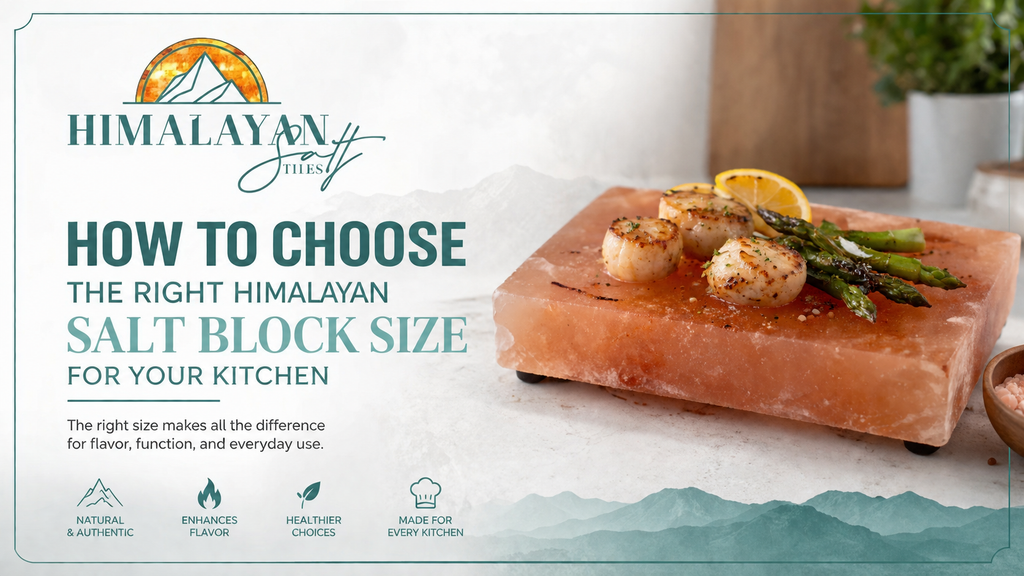
For searing and grilling (steaks, shrimp, scallops): an 8"x8"x1.5" block gives you enough surface area to sear two to three servings at once without overcrowding. If you're cooking for a bigger group or run a restaurant, our wholesale cooking block, 12"x8"x1.5", gives you more room without needing a second block.
For serving cold food (cheese, sushi, charcuterie, oysters): thinner tiles work fine since there's no thermal stress involved. Our 8"x4"x1" salt tiles are a common choice for a cheese board or a couple of appetizer plates.
For everyday home cooking (two to four people): an 8"x4"x2" salt brick is the size most home cooks land on. It's thick enough to handle a stovetop sear and small enough to store flat in a drawer or on a shelf.
For a dedicated cooking centerpiece, the 8"x8"x1" salt block is a middle ground between our tiles and bricks, wide enough to plate a full meal on the table after cooking.
How many people does a Himalayan salt block feed
As a rough guide, a 6"x6" surface handles about one main-course serving. An 8"x8" block covers two to three servings comfortably. If you're regularly cooking for five or more, or hosting often, it's worth sizing up rather than running two smaller blocks side by side, since two blocks heat unevenly and take up more stovetop space than one larger one.
Storage and counter space for your salt block
An 8"x8" block weighs around 6 to 8 pounds, depending on thickness, and it doesn't flex or bend, so it needs a flat spot to rest, either a drawer, a lower shelf, or a dedicated tray. If your kitchen storage is tight, a smaller tile or brick is genuinely easier to live with day to day, even if it means cooking in two batches instead of one.
A quick way to decide on salt block size
Ask yourself two questions before buying. First, will this touch direct heat, or is it just for serving? That tells you the thickness you need. Second, how many people are you usually cooking for? That tells you the surface area. Most sizing mistakes come from skipping the first question and buying based on price or looks alone.
Caring for your block once you've picked a size
Whatever size you choose, the maintenance is the same: let it dry fully between uses, avoid soap (salt is naturally antibacterial), and store it somewhere it won't sit in moisture. We cover the full process, including how to handle the first few uses, in our guide on uses and cleaning for Himalayan salt blocks.
Common questions about salt block sizing
Can I use a thin salt tile on the grill? Not recommended. Tiles under an inch thick are prone to cracking under direct or high heat. Use them for serving or chilling instead, and pick a brick or block at 1.5 inches or more for grilling.
What size salt block is best for two people? An 8"x4"x2" brick usually covers dinner for two without leftovers needing to sit on a cooled block. If you like generous portions or want room to sear sides alongside a main, size up to an 8"x8".
Do bigger blocks cook food faster? No. A larger block just gives you more surface area at once. Cooking speed depends on thickness and how long you preheat it, not overall size.
Looking at salt blocks, salt bricks, or salt tiles, and still not sure which fits your kitchen? Send us your typical serving size and how you plan to cook, and we'll point you to the right one.
-
Posted in
Himalayan Salt Block, Himalayan Salt Brick